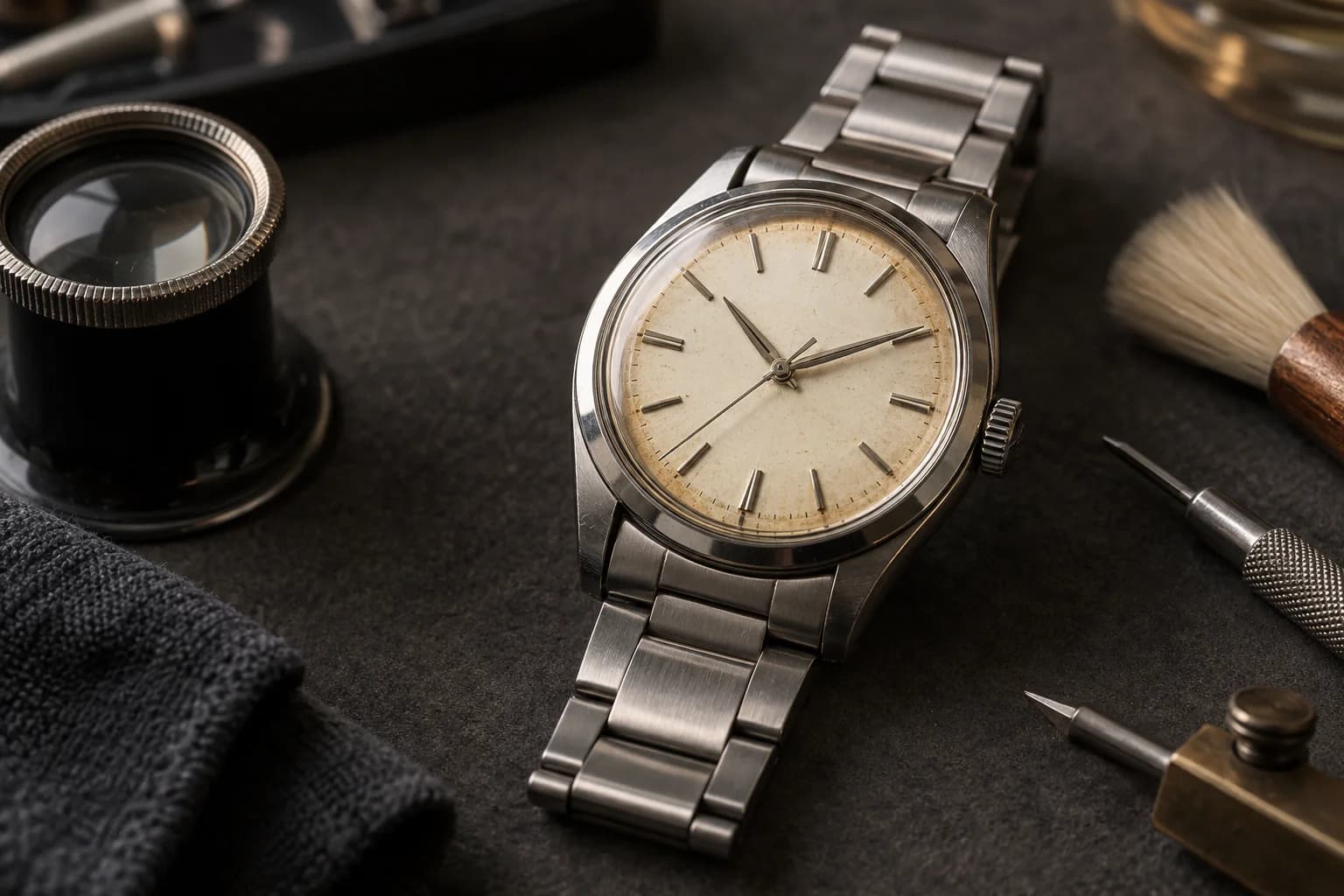
Photographs can reveal a great deal about a vintage watch, but only when they are sharp, neutrally lit and show the actual piece from several angles. They are most useful alongside measurements, service history and a clear account of previous work. A beautiful hero image is not a condition report.
Dial and hands
Look for consistency across the surface, clean edges around the markers, hand alignment and any staining. Natural patina may be part of the appeal, but language should be precise: colour change, moisture and physical damage are not the same. Ask whether the dial or hands have been restored or replaced.
Case, bezel and crown
Images taken in angled light reveal scratches, dents and the definition of case edges. Polishing is not automatically negative, but it can alter original lines. Compare both sides of the case, the junction between lugs and bracelet, and how the crown sits.
Bracelet and clasp
Check for link stretch, damaged screws, secure closure and sufficient bracelet length. Spare links matter when the watch needs to fit a larger wrist. A leather strap is a consumable component; its condition does not necessarily describe the condition of the watch itself.
Movement and service
A movement photograph is useful only when the case has been opened safely by a qualified person. More valuable information includes timekeeping, power reserve, crown and chronograph operation, and evidence of service. Never assume water resistance on an older watch without a recent test.
What to ask before a viewing
Request unedited images, a short video of the watch running and a written list of known replacement parts. “Excellent condition” is an opinion; photographs, measurements and invoices are evidence that may support it. For an important purchase, confirm the final assessment by examining the actual watch.